
Hiring Your First Employee in 2026: 9 Steps, the Job Advert and the Real Monthly Cost
How to hire your first employee in the UK in 2026: the real monthly cost once employer NI, the Employment Allowance and the pension are counted, nine steps in order, where to advertise free, the Equality Act rules for the advert, the day-one rights since April 2026, and the prompts an AI agent uses for the advert, the scorecard and the contract.
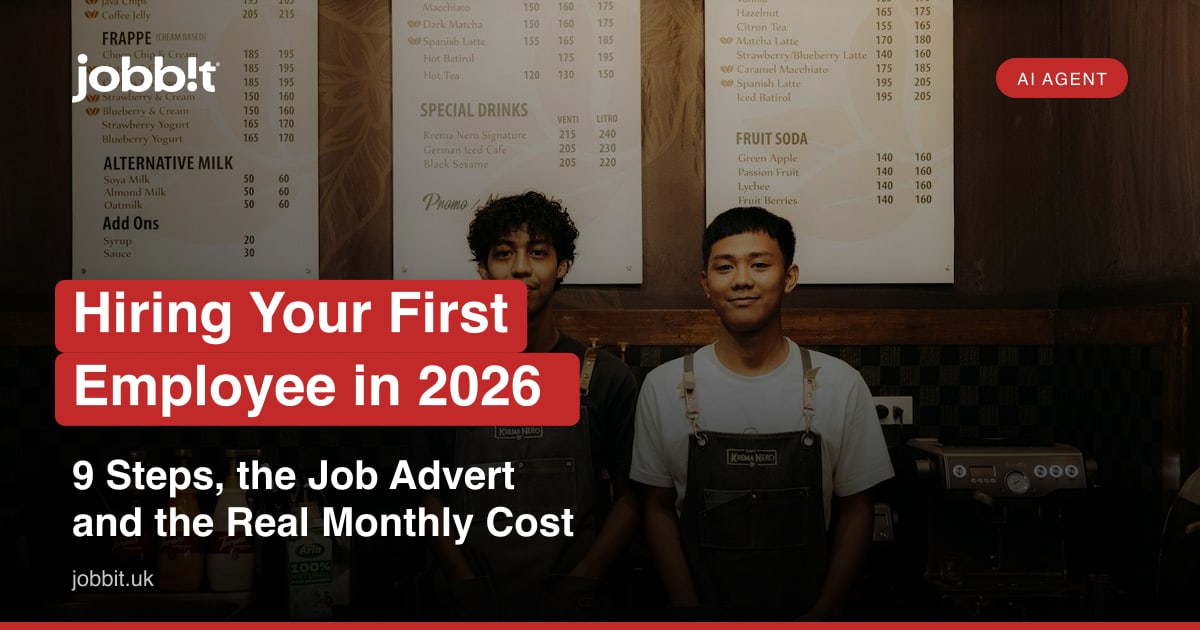
The first hire is the moment a business stops being a job. A cafe owner working 60-hour weeks, a plumber turning away work, an online seller packing orders at midnight: each of them knows the next step is a person, and each of them has put it off because the paperwork looks like a wall. HMRC registration, a pension scheme, employers' liability insurance, a contract, a payslip every month, and a job advert that does not accidentally break the Equality Act 2010.
The wall is lower than it looks. There are nine steps, most of them take an hour, and the documents can be drafted by an AI agent from a short description of the job. This guide shows how to hire your first employee in the UK in 2026: what the person actually costs once the Employment Allowance is counted, the nine steps in the order HMRC and The Pensions Regulator expect, where to advertise without paying, the words to keep out of the advert, the day-one rights that changed in April 2026, and the prompts that get the advert, the interview scorecard and the written statement drafted before lunch. The rates are from GOV.UK and The Pensions Regulator for 2026/27, checked on 21 October 2026.
Want the advert drafted while you read? Open Jobbit, paste prompt 1 below with your hours, pay and three duties, and you will have an advert that passes the Equality Act check in under a minute. Free plan, 100 credits a day, no card.
What a first employee really costs
Take the common case: a shop or cafe hiring one person for 30 hours a week at the National Living Wage, which is £12.71 an hour for anyone 21 and over since 1 April 2026.
| Cost line | A year | A month | Note |
|---|---|---|---|
| Gross pay | £19,828 | £1,652 | 30 hours x £12.71 x 52 weeks |
| Employer National Insurance | £2,224, usually £0 | £0 | 15% on pay above £5,000 a year, but the Employment Allowance wipes up to £10,500 of it for most first employers |
| Workplace pension | £408 | £34 | 3% of qualifying earnings between £6,240 and £50,270, because the employee earns over the £10,000 trigger |
| Holiday | Included | Included | 5.6 weeks of paid leave are part of the gross pay, not on top; 3 days a week is 16.8 days |
| Employers' liability insurance | Varies | Varies | A legal requirement, usually added to a business policy; get a quote |
| Payroll software | £0 to about £20 | £0 to about £20 | HMRC's Basic PAYE Tools is free for fewer than 10 employees |
| Total before insurance | About £20,236 | About £1,686 | Pay plus pension; NI covered by the allowance |
The figure that surprises most first employers is the National Insurance line. Employer NI is 15% on everything above £5,000 a year, which would be £2,224 on this salary. The Employment Allowance lets most employers knock up to £10,500 a year off their employer NI bill, so a first hire at this level costs nothing in employer NI. The exception is a limited company where the only person paid above the threshold is a director; once a second person is on the payroll above the threshold, the allowance can be claimed. The £100,000 eligibility cap on the allowance was removed in April 2025.
The rates for the other age bands from 1 April 2026 are £10.85 an hour for 18 to 20, £8.00 for under 18 and £8.00 for apprentices.
The 9 steps in order
- Check the person will be an employee. GOV.UK's first step is to confirm employment status: if you set the hours, supply the kit and pay a wage, that is an employee, with all the rights below. A self-employed contractor who invoices you is a different relationship and a different post.
- Write the advert and the job description. Pay, hours, duties, where the work is, and how to apply. The Equality Act rules are in the next section, and prompt 1 drafts it.
- Advertise where it is free. GOV.UK's Find a job service is free. Indeed lets a UK employer post up to 3 jobs a month free, each live for up to 30 days, with sponsored listings charged per click or per started application and a £100 credit for new accounts. LinkedIn allows one free job post active at a time, live for up to 14 days. Reed charges £89 plus VAT for a first Premium credit, live for six weeks, with pay-per-application as the no-upfront option.
- Interview against a scorecard. Four or five criteria scored 1 to 5, the same questions for every candidate, notes kept. Prompt 2 writes it. The same scorecard is your defence if a rejected candidate asks why.
- Check the right to work before the start date. Three routes: the online check with the candidate's share code, a manual check of original documents, or an identity service provider. The Home Office code of practice and the employer's guide were updated on 1 October 2026. The civil penalty for employing someone without the right to work has been £45,000 per worker for a first breach and £60,000 for a repeat since 13 February 2024, and the check is the only defence.
- Register as an employer with HMRC. You must register before the first payday and cannot register more than 2 months before you start paying people. The PAYE Online activation code arrives by post within 10 days. If the reference has not arrived by payday, GOV.UK says to run the payroll, keep the Full Payment Submission and send it late.
- Get employers' liability insurance. Compulsory from the day the person starts, minimum cover £5 million, fines of up to £2,500 for every day without it and £1,000 for not displaying the certificate.
- Give the written statement on day one. Since 6 April 2020 the principal statement (job title, pay, hours, holiday, place of work, probation, notice, training the employee must do) is due on or before the first day, and the wider statement within 2 months. Prompt 3 drafts it from your answers.
- Run payroll and the pension from the first payday. Under Real Time Information the Full Payment Submission goes to HMRC on or before every payday. Pension auto-enrolment duties start on the first worker's start date: anyone aged 22 to State Pension age earning £10,000 or more a year must be enrolled, the employer pays at least 3% of qualifying earnings (8% in total), and the declaration of compliance is due to The Pensions Regulator within 5 months of the start date.
The advert, and the words that break the Equality Act
A job advert must not state or imply that you will discriminate on a protected characteristic: age, disability, sex, race, religion, sexual orientation, pregnancy, marriage, or gender reassignment. ACAS's recruitment guidance, updated 30 June 2026, gives the phrases that go wrong: "recent graduate" and "highly experienced" are age risks, "barmaid" and "handyman" are sex risks, and "German sales rep" is a race risk when what you mean is "German-speaking". The fix is always the same: describe the work, not the person.
A good first advert has six parts: the job title people actually search for, the pay (a number, not "competitive"), the hours and days, five duties in plain words, the three things you need the person to be able to do on day one, and how to apply with a closing date. Everything else is noise.
Message to send
Write a job advert for a part-time cafe assistant at Luna Coffee, 30 hours a week over Tuesday to Saturday, £12.71 an hour, starting 1 December. Duties: serving customers, making coffee on a La Marzocco machine after training, clearing tables, closing down, taking card payments. Must be able to: work Saturdays, lift a 10 kg milk crate, talk to customers. Apply by email with a short note by 14 November. Keep it under 250 words, plain English, no jargon, and check it against the Equality Act 2010: no words that imply an age, sex, race or any other protected characteristic.
You create a free account first (an email address is all it takes, no card). Your message is kept and sent the moment you are in.
Message to send
Turn that advert into an interview scorecard: five criteria scored 1 to 5 with a one-line description of what a 1, a 3 and a 5 look like, eight questions I ask every candidate in the same order, and a note on which questions I must not ask (health, family plans, age, nationality beyond the right to work check). Add a 15-minute practical test on the coffee machine and a till.
You create a free account first (an email address is all it takes, no card). Your message is kept and sent the moment you are in.
Where to advertise free or cheap
| Where | Cost (21 October 2026) | How long it runs | Best for |
|---|---|---|---|
| Find a job (GOV.UK) | Free | Until you close it | Every job; Jobcentre advisers push it to claimants |
| Indeed | 3 free posts a month; sponsored per click or per started application, £100 credit for new accounts | Up to 30 days free | Volume of applicants for shop, cafe and trade roles |
| One free post active at a time | Up to 14 days, auto-closes after 30 | Office, sales and professional roles | |
| Reed | £89 plus VAT for a first Premium credit; pay-per-application with no upfront cost | Up to 6 weeks | Admin and professional roles |
| Your own site and Google Business Profile | Free | As long as you like | Local roles; link it from every social post |
The paperwork an agent drafts
The documents are standard, the answers are yours, and an agent fills the gap between the two. The written statement uses GOV.UK's list of required particulars. The onboarding checklist uses the steps above. Neither needs a solicitor for a straightforward role, and both are checked against a short list before they go anywhere.
Message to send
Draft the written statement of employment particulars for the cafe assistant role, following GOV.UK's required contents: employer and employee names, start date, job title, pay and when it is paid, hours and days, holiday entitlement calculated at 5.6 weeks pro rata for a 5-day week of 6 hours, place of work, a 3-month probation period, notice periods, sick pay at the statutory rate, the pension scheme, and any training the employee must complete. Plain English, UK law, no clauses I have not described.
You create a free account first (an email address is all it takes, no card). Your message is kept and sent the moment you are in.
Message to send
Make me a first-employee checklist with dates working back from a 1 December start: HMRC employer registration, employers' liability insurance, the right-to-work check and what to keep on file, the pension scheme set-up, the Full Payment Submission on payday, the declaration of compliance deadline, and the written statement on day one. Email it to me as a table with a box to tick.
You create a free account first (an email address is all it takes, no card). Your message is kept and sent the moment you are in.
For a cafe, a shop or a trade, add a short staff handbook: hours, breaks, sickness reporting, phone use, tips, and the AI rules if the person will use the business's tools. The AI policy template covers the last part, and the document generator guide covers the other fourteen documents a small business ends up needing.
The day-one rights that changed in 2026
The Employment Rights Act 2025 is arriving in stages, and a first employer should plan for the dates on the government's timeline, updated 14 October 2026:
- Since 6 April 2026: Statutory Sick Pay from the first day of sickness, with the waiting days and the lower earnings limit removed. SSP is £123.25 a week or 80% of normal weekly earnings, whichever is lower, for up to 28 weeks. Paternity leave and unpaid parental leave are day-one rights.
- Since October 2026: the time limit for bringing an employment tribunal claim is six months, and employers must take all reasonable steps to prevent sexual harassment.
- From 1 January 2027: the qualifying period for unfair dismissal falls from two years to six months, and fire-and-rehire protections apply.
- In 2027, date to be confirmed: zero-hours workers gain a right to a guaranteed-hours offer, reasonable notice of shifts and pay for short-notice cancellations.
Statutory Maternity Pay in 2026/27 is 90% of average weekly earnings for six weeks, then £194.32 a week or 90%, whichever is lower, for 33 weeks. Holiday is 5.6 weeks a year, capped at 28 days, pro rata for part-timers.
How an AI agent differs from a template site
ChatGPT, Claude, Gemini, Microsoft Copilot, Manus and Meta's Muse will all draft an advert if you ask. Jobbit runs the hire from the first draft to the first payday:
- It drafts the advert and checks it against the Equality Act list before you see it.
- It builds the scorecard and keeps the notes, so every candidate is judged on the same five things.
- It writes the written statement from your answers and keeps the dates that matter.
- It makes the checklist with deadlines from the start date, and emails you the week before each one.
- It posts the role to your own site and drafts the Find a job and Indeed listings in the right format.
- It reminds you about the declaration of compliance before the five months run out.
A two-week plan
- Day 1. Write the role in ten lines: hours, pay, duties, start date. Run prompts 1 and 2.
- Day 2. Post on Find a job, Indeed and your Google Business Profile. Tell your regulars.
- Days 3 to 9. Interview with the scorecard. Keep the notes.
- Day 10. Make the offer in writing, subject to the right-to-work check. Run the check.
- Day 11. Register as an employer with HMRC. Get the employers' liability quote. Choose a pension scheme.
- Day 12. Run prompts 3 and 4. Read the written statement once, slowly.
- Day 14. Set up payroll, enter the start date, and put the declaration of compliance deadline in the diary.
Draft the advert, the scorecard and the contract on the free plan: 100 credits a day, no card.
Open JobbitRead next
- Should your next hire be an AI agent?: the nine roles an agent can fill and the four it cannot.
- AI document generator: the fifteen documents a small business needs, drafted free.
- 12 jobs an AI agent can do for your business this week: the admin that goes first.
Frequently asked questions
How much does it cost to hire your first employee in the UK?
For a 30-hour-a-week employee on the National Living Wage of £12.71, gross pay is about £19,828 a year. Employer National Insurance at 15% above £5,000 would be £2,224, but the Employment Allowance covers up to £10,500 of employer NI for most first employers, so it is usually nothing. The pension adds about £408 a year at the 3% minimum, giving roughly £20,236 before employers' liability insurance and payroll software.
When do I need to register as an employer with HMRC?
Before the first payday, and not more than 2 months before you start paying people. The PAYE Online activation code comes by post within 10 days. If your reference has not arrived by payday, run the payroll anyway, keep the Full Payment Submission and send it as soon as the reference arrives.
Do I have to offer a pension to my first employee?
Your duties start on the day the first worker starts. Anyone aged 22 to State Pension age who earns £10,000 or more a year must be enrolled, with the employer paying at least 3% of qualifying earnings between £6,240 and £50,270. You then declare compliance to The Pensions Regulator within 5 months of the start date.
What must a job advert not say?
Anything that states or implies a preference on a protected characteristic. ACAS gives "recent graduate" and "highly experienced" as age risks, "barmaid" and "handyman" as sex risks, and "German sales rep" as a race risk. Describe the work and the skills needed, and ask an agent on Jobbit to check the draft before it goes out.
Where can I advertise a job for free?
GOV.UK's Find a job is free with no limit. Indeed allows 3 free posts a month, each live for up to 30 days. LinkedIn allows one free post at a time for up to 14 days. Your own website and Google Business Profile cost nothing and work well for local roles.
What is the penalty for not checking the right to work?
Since 13 February 2024 the civil penalty is up to £45,000 per worker for a first breach and £60,000 for a repeat breach. A correct check before the start date, kept on file, is the statutory excuse. The Home Office employer's guide was updated on 1 October 2026.
Can an AI agent write an employment contract?
It can draft the written statement of employment particulars from GOV.UK's required list and your answers, which is what a first employee needs on day one. For anything unusual, such as restrictive covenants, commission schemes or a role abroad, have a solicitor read the draft. An agent on Jobbit drafts the statement, the staff handbook and the onboarding checklist in one session, free on the 100 credits a day.